

The Illusion of Equipment-Based Progress
Climbers often assume:
- A better hangboard builds stronger fingers.
- A campus board builds power.
- A grip tool builds crushing strength.
But tools do not create adaptation.
They create stress environments.
Adaptation happens only if that stress:
- Exceeds previous exposure
- Is specific to the target system
- Is recoverable
- Is repeated consistently
The tool is secondary.
The stimulus is primary.
Strength Is a Biological Response, Not a Device Property
Muscle, tendon, and nervous system adapt to:
- Mechanical tension
- Load magnitude
- Rate of force development
- Time under tension
- Frequency of exposure
None of these variables are inherent in a tool.
A hangboard can produce:
- Effective overload
- Or meaningless volume
A gripper can produce:
- Productive neural recruitment
- Or repetitive fatigue with little transfer
The difference lies in how stress is applied.
Tools as Stress Modulators
Every training tool modifies one or more of these variables:
| Variable | Tool Influence |
|---|---|
| Load magnitude | Added weight, leverage |
| Force direction | Vertical, rotational, compressive |
| Stability | Fixed vs rotating surfaces |
| Isolation | Single joint vs integrated movement |
| Measurability | Load tracking capability |
For example:
- A hangboard increases isolation and measurability.
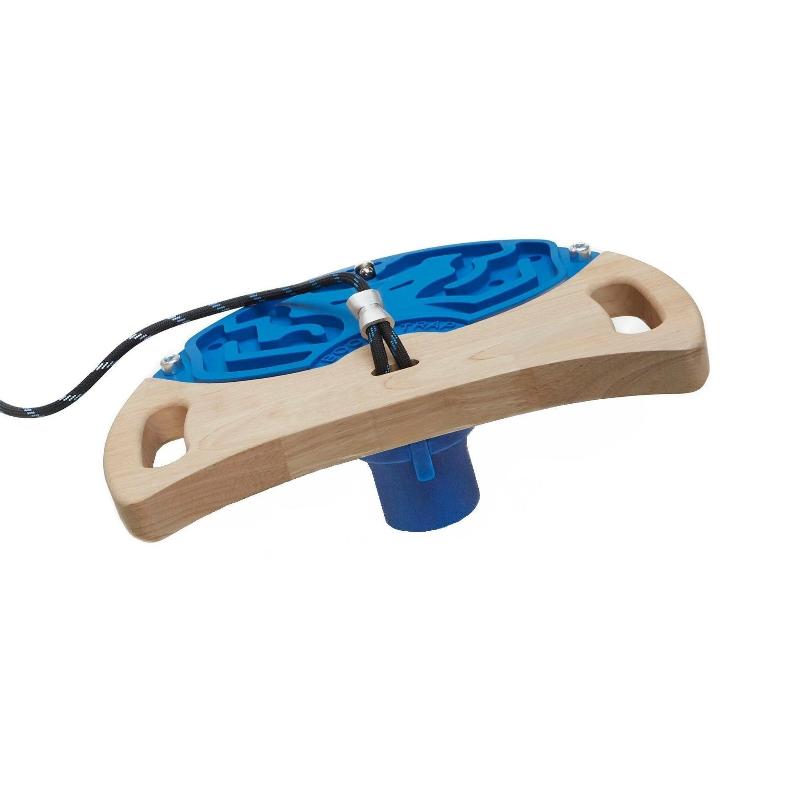
- A rolling handle increases instability and recruitment demand.
- A pronator tool increases rotational torque exposure.
But none of them automatically guarantee adaptation.
They simply change the mechanical context.
The Core Mechanism: Progressive Overload
Progress requires progressive overload.
If a tool does not allow:
- Clear progression
- Controlled intensity
- Repeatable exposure
It becomes difficult to drive adaptation.
This is why:
- Random circuits rarely build maximal strength.
- Excessively complex tools often reduce measurable overload.
Simplicity often wins because it preserves clarity.
The Transfer Question
The real question is not:
“Is this tool good?”
It is:
“Does the stress it produces transfer to climbing performance?”
Transfer depends on:
- Joint angles
- Grip specificity
- Contraction type (isometric vs concentric)
- Rate of force
- Structural similarity
Some tools build general capacity.
Some build specific strength.
Some build structural tolerance.
Few build everything.
When Tools Become Psychological Crutches
There is a hidden risk:
Using tools to feel productive.
Buying equipment creates the illusion of progress.
But if stress variables do not change:
- Load stays constant
- Intensity remains submaximal
- Volume becomes excessive
Adaptation stalls.
The tool becomes decorative.
The Hierarchy of Training Tools
Effective tools typically share:
- Measurability
- Simplicity
- Repeatability
- Clear overload potential
Ineffective tools often:
- Blur stimulus
- Increase fatigue without increasing intensity
- Prioritize complexity over clarity
More features rarely mean more adaptation.
The Practical Filter
Before adding any tool to your training, ask:
- What mechanical variable does this change?
- Can I progressively overload it?
- Is the stress specific to my limitation?
- Is the adaptation worth the recovery cost?
If you cannot answer clearly, the tool is not the problem.
The programming is.
The Core Principle
Tools do not create strength.
Stress creates adaptation.
Tools only matter when they allow:
- Precise stress
- Progressive overload
- Recoverable intensity
- Transfer to performance
Everything else is equipment.