
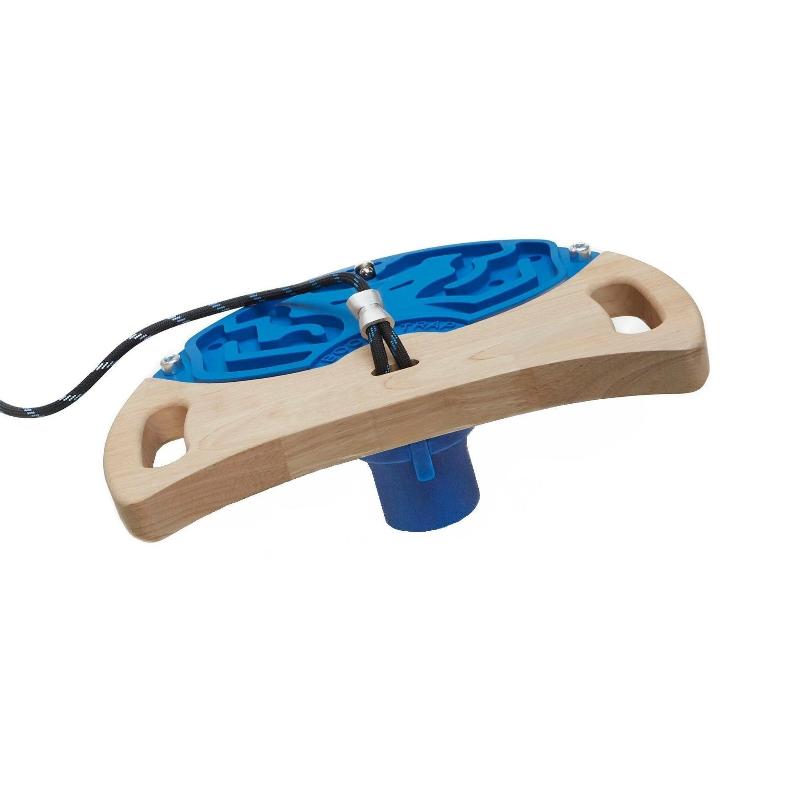


Finger strength training only works if the load reaches the tissues without exceeding their structural tolerance.
Most finger injuries come from bad progression, not from high-intensity training itself.
This article gives the mechanical rules that let you increase force safely and predictably.
1. The Biological Problem: Fast Neural Gains vs Slow Tissue Gains
Neural systems adapt in days.
Tendons, pulleys and bone adapt in weeks to months.
This creates a time-bomb:
- your nervous system learns to produce more force quickly
- your connective tissues strengthen slowly
- you feel stronger before you actually are stronger
- this gap is where nearly all injuries occur
Safe progression is the management of this gap.

2. The 2–5% Rule: The Only Reliable Progression Rate
Finger tissues respond best to small, continuous increases in load.
The guideline:
Increase load by 2–5% per week (or per cycle), not more.

Examples:
- adding 1–2 kg to a 40 kg hang
- reducing edge depth by 1–2 mm
- adding 2–5 seconds of total time under tension
- adding one small rep in a repeater series
Exceeding this by a large margin forces tissues into overload without giving them time to remodel.
Your nervous system can tolerate huge jumps.
Your pulleys cannot.
3. Mechanical Load Changes That Are Risky
Some changes multiply force more than climbers realise:
Switching grip type
- open → half crimp → full crimp
This is not a “technique change”: it's a dramatic mechanical load increase on A2 and A4.

Increasing edge depth variability
Jumping from a 20 mm edge to a 10 mm edge increases first-joint torque disproportionately.
Increasing duration at high intensity
A 5-second hang at 95% is not equivalent to a 10-second hang at 95%.
Time amplifies load.
Reducing rest too early
Rest management is part of load management.
Reducing rest increases effective intensity because recruitment remains elevated.
Do not progress multiple variables at once.
4. Stability Before Intensity
Unstable finger positions — twisting, collapsing DIP joints, uneven force spread — multiply stress.
Stability strength acts as a force stabiliser. Without it:
- peak force spikes
- connective tissue gets uneven loading
- small positional errors become structural strain
Safe progression requires clean mechanics:
- fingers aligned
- DIP not collapsing
- even left–right loading
- shoulder and scap position stable
- no rotation of the forearm during contraction
You do not increase intensity until stability is consistent.
5. Micro-Signs of Overload (Ignored by Most Climbers)
These signals appear days before an injury and are almost always missed:
- weird tightness in one finger on warming up
- vague soreness in the palm or forearm the next morning
- clicking at A2 or A4
- difficulty generating normal force despite feeling rested
- discomfort when pressing the fingertip into a table
- “ropey” tension along one tendon
- DIP collapse that wasn’t there before
If any of these appear, progression stops immediately — and often even unloading for a week is wise.
6. Why Chaos Training Breaks People
Random, unstructured climbing (“chaos training”) generates unpredictable loads:
- inconsistent joint angles
- sudden grip changes
- dynamic tension spikes
- no control over intensity progression
Chaos is fun, but mechanically it has the worst load distribution possible.
This is why unstructured climbing contributes to far more pulley injuries than hangboard training.
Use controlled training for progression; use climbing for skill.
7. Build Strength like a Load-Bearing Structure
Finger progression works like structural engineering:
- increase load slowly
- increase load predictably
- maintain alignment
- avoid stress concentrations
- reinforce weak points (stability muscles)
- test capacity under controlled conditions
When these principles hold, high-intensity finger training is extremely safe — even safer than normal climbing.
8. A Simple Progression Framework
A safe progression cycle:
-
Establish a baseline
Measure your current max or your current sustainable loading. -
Increase only one variable
Load, duration, edge depth, or volume — never multiple. -
Apply the 2–5% rule
Stay within tolerance. -
Track stability
If form decays, reduce intensity. -
Monitor tissue response
Use next-day stiffness and warm-up quality as your diagnostic tools. -
Deload regularly
Every 3–6 weeks, reduce intensity or switch to capacity work.
This produces long-term strength gains without setbacks.
Apply this in practice
- For controlled intensity + volume → follow the Density Hangs Protocol or Density (pinch blocks)
-
For higher intensity work → follow the Max Hangs Protocol or Max lifts (pinch blocks)
- For repeatable submaximal efforts → follow the Repeaters Protocol
- To measure your current level → follow the Finger Testing Protocol
Tools that match this approach
Hangboards — for controlled, repeatable edge loading
Portable edges — for progressive loading with added weight
Pinch blocks — for isolating thumb-dependent grip strength
Loading pin — to precisely control intensity across all tools