


1. The Structural Question
Climbing makes you better at climbing.
But does it make you stronger in the most efficient way possible?
That’s not a rhetorical question. It’s a structural one.
Climbing distributes load across constantly changing joint angles, shifting force vectors, and irregular contraction speeds. From a skill perspective, this variability is powerful.
From a strength-development perspective, it creates a problem.
Strength and hypertrophy respond best to repeated, high mechanical tension under controlled conditions. Progressive overload requires consistency — not just effort.
Climbing provides tension.
But rarely in a controlled, repeatable way.
2. Optimization vs Capacity
Climbing is an optimization sport.
The body learns to:
- reduce unnecessary muscle recruitment
- improve timing
- refine hip positioning
- use skeletal alignment over brute force
As technique improves, required force decreases.
This creates an important distinction:
You can improve performance
without increasing structural capacity.
In other words:
You may become more efficient within your current strength ceiling
rather than raising the ceiling itself.
This is not a flaw in climbing.
It is a property of skill-dominant systems.
3. The Variability Problem
Strength adapts through repetition under consistent conditions.
In a controlled setting, that’s straightforward:
same movement, same load, measurable progression.
On the wall, none of this is stable.
Holds change.
Angles change.
Force distribution shifts between attempts.
Even when effort is high, the actual mechanical tension applied to specific tissues may not accumulate in a way that drives maximal adaptation.
Climbing challenges many muscles.
It rarely overloads any of them systematically.
4. Masked Weakness
Climbers adapt around their strengths.
If pulling strength is low, technique compensates.
If lock-off strength is limited, movement becomes dynamic.
If pushing strength is weak, top-outs are avoided or optimized differently.
Skill hides structural deficits.
Until it can’t.
At higher intensities, capacity becomes the limiter.
Not movement intelligence.
Not creativity.
Force production.
Quick check
If this sounds familiar:
- You climb more, but don’t feel stronger
- Small holds don’t improve despite volume
- You rely on movement to avoid hard pulling
→ strength is likely the limiter
5. The Hypothesis
Wall = coordination, timing, efficiency.
Gym = progressive overload, hypertrophy, neural force output.
Performance emerges from their integration.
This is not an argument against climbing more.
It is a structural question:
If maximal strength adapts best under controlled overload,
and climbing distributes load too variably to provide that stimulus consistently,
then structured off-wall strength training may raise the performance ceiling more efficiently than additional climbing volume.
6. The Risks
Separation is not without danger.
- Excess hypertrophy may reduce power-to-weight ratio.
- Poorly designed strength work can interfere with recovery.
- Movement patterns may stiffen if skill exposure drops.
The goal is not replacement.
It is sequencing.
Build capacity.
Apply it skillfully.
The trade-off
- More strength → better force production
- Too much mass → worse power-to-weight
- Poor timing → strength doesn’t transfer
👉 Strength only works if you still climb.
7. A simple model
This model suggests a simple framework:
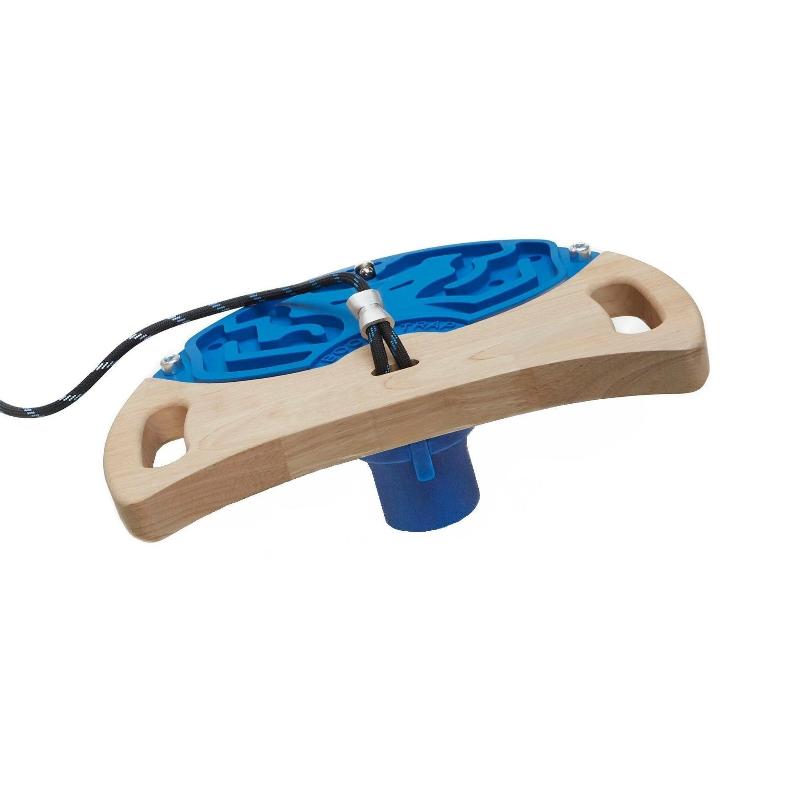
Develop structural strength off the wall. (with hangboards, lifting tools)
Develop coordination and application on the wall. (or board climbing)
Avoid asking climbing to do both at once, inefficiently.
Whether this is superior remains to be tested.
But the structural question stands:
Have we been asking the wall to do too much?
What to do with this
If you rely only on climbing:
- you improve efficiency
- but strength may lag behind
If you want to raise your ceiling:
👉 Separate the goal:
- Build strength off the wall
- Apply it on the wall
Start here
Build strength (off the wall):
Apply it (on the wall):
- Board climbing
- Limit bouldering
Use: