
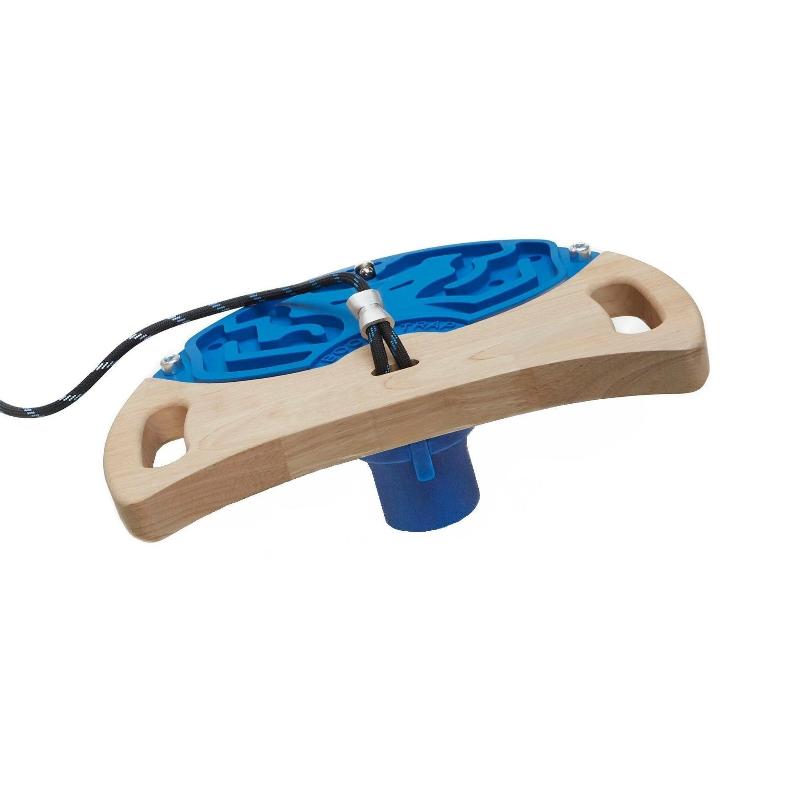


Weighted pinch tools — blocks, cylinders, bricks, plates — emphasize:
- Lateral thumb–finger compression
- Open-hand tension continuity
- Radial/ulnar deviation control
- Wrist-centered torque stability
Mechanically, this differs from:
- Isometric edge loading
- Crimp-angle stability
- Friction-dominant gripping
- Vertical pulling force lines
Pinch tools train lateral force, not vertical edge tension.
Climbing uses both — but in different ways.
This difference matters.
The Biomechanical Mismatch
On an edge:
- Force travels along the flexor tendon line
- PIP and DIP angles determine stability
- Load is isometric and continuous
- Wrist position remains structurally locked
With weighted pinches:
- Force travels sideways across the thumb–finger axis
- Wrist rotates subtly to manage torque
- Load shifts as the block drifts
- Stability depends on open-hand tension, not bony leverage
This alters:
- Thumb adduction demand
- Torque absorption at the wrist
- Recruitment of deep forearm stabilizers
- Force direction relative to gravity
The neural pattern is not identical.
Transfer is therefore specific, not general.
Where Pinch Tools Are Useful
Weighted pinches excel at developing:
- Thumb strength (a major limiter in many climbers)
- Lateral compression capacity
- Open-hand recruitment under high load
- Wrist torque control for slopers and volumes
- Structural resilience in the thumb–index unit
They are also valuable when:
- Board-style pinch positions are inconsistent for overload
- Sloper performance is limited by torque, not friction
- Climbers need measurable loading in a force vector climbing rarely isolates
- Structural capacity has plateaued on edges
Pinches provide clear overload on a mechanical system that climbing depends on — but rarely overloads predictably.
Where Pinch Tools Fall Short
Pinch tools are less useful when:
- Edge strength is the primary limitation
- Half-crimp stability is underdeveloped
- Small-hold performance is the bottleneck
- Tendons need angle-specific conditioning
- Friction, not compression, determines success
Lateral compression ≠ vertical edge force.
They overlap — but they are not interchangeable.
Lateral Force vs Vertical Force
Weighted pinches improve:
- Thumb-driven compression
- Lateral torque resistance
- Global forearm tension
- Open-hand engagement
But they do not replicate:
- Finger-angle stability
- Small-edge tendon stress
- Friction-based grip mechanics
- Controlled edge recruitment
Specific adaptation still requires edge exposure.
Structural Considerations
Pinches load:
- Thumb joints (CMC, MP) under lateral stress
- Wrist stabilizers during subtle rotation
- The entire open-hand tension chain
- Forearm musculature under non-linear force paths
But they do not condition:
- A2/A3/A4 pulley loading
- PIP/DIP angular endurance
- Edge tolerance under fatigue
- High-friction finger alignment
They are structural tools — for a different structure than edges.
The Psychological Pull
Pinch tools feel productive:
- Heavy weights
- Tangible loading
- Clear progression
- Visually obvious difficulty
But this can create a misleading conclusion:
“My pinch strength improved, so my climbing will improve.”
Not necessarily.
If the bottleneck is:
- Edge strength
- Tendon capacity
- Crimp mechanics
- Friction management
- Timing and movement
then pinch strength will not change performance.
Pinches solve one problem, not all problems.
Intelligent Use
Pinch tools integrate well:
- In accessory strength blocks
- In sloper preparation phases
- When thumb weakness is the limiter
- As supplemental instability training
- In structured capacity work for wide holds
But they should not replace:
- Hangboard edge work
- Applied strength on boards
- Tendon-specific structural loading
- Technique-based sloper mechanics
They are supplements, not foundations.
The Core Principle
Weighted pinch tools build lateral compression strength.
Climbing demands:
- Vertical edge tension
- Lateral stability
- Open-hand torque control
- Isometric precision under friction
These are related — but not the same.
Used strategically, pinch tools expand the force vectors your hands can control.
Used as primary strength work, they leave critical systems underdeveloped.
Strength must ultimately be trained in the joint angles, force directions and mechanical patterns that climbing performance requires.