

Why Slopers Are Different
Slopers are not just “big holds.”
They create a different force problem than edges. On an edge, your fingers can often find a mechanical locking point. The hold gives you a clear direction to pull against, and finger flexion strength becomes the dominant factor.
On a sloper, that advantage disappears. There is no sharp edge to lock onto. Friction, pressure and body position matter much more.
To stay on a sloper, you need high normal force: the ability to press into the hold hard enough to create usable friction. But that pressure has to be controlled through an open-hand position, supported by the wrist, forearm and shoulder.
That is why slopers demand more than finger strength. They require open-hand recruitment, wrist stabilization, forearm rotational control and constant micro-adjustment.
The demand shifts from pure flexion strength toward stabilization strength.
What Rolling Handles Actually Do

Rolling handles do not copy the shape of a sloper.
Their value is mechanical. A fixed bar gives you a stable grip orientation. A rolling handle removes that stability. Because the handle can rotate, you cannot simply lock your fingers into position and pull.
You have to keep controlling the handle while producing force.
That increases recruitment demand through the fingers, wrist and forearm. The grip becomes less passive. The wrist has to stabilize, the forearm has to resist rotation, and the fingers have to maintain pressure without relying on a fixed orientation.
This resembles the instability profile of slopers, not their exact shape.
That distinction matters. Rolling handles are not “slopers simulators.” They are tools that train part of the force environment that makes slopers difficult.
Thick Bars: Diameter Changes Mechanics
Thick bars change the problem in a different way.
As the diameter increases, your fingers overlap less around the implement. You lose mechanical leverage. The grip becomes more open-hand biased, and the advantage of a crimp-like finger position disappears.
This makes the grip less efficient.
Because the fingers cannot wrap as easily, the forearm has to produce more global compression. The flexor system has to work under reduced mechanical advantage, and the nervous system has to recruit harder to maintain pressure.
The result is a grip stimulus that is closer to sloper demands than a normal bar or edge.
Not because the shape is the same.
Because the mechanics are less favorable.
Why This Transfers to Slopers
Sloper performance depends on more than contact strength.
You need open-hand force tolerance, torque stability, wrist integrity and the ability to keep producing pressure while the position constantly changes.
Rolling handles and thick bars train parts of that system. They develop anti-collapse recruitment, rotational stabilization and open-hand force endurance.
They do not teach sloper technique. They will not replace learning how to position your body, control your center of mass or use directionality on real holds.
But they can improve the physical environment behind good sloper performance.
In other words: they do not teach you how to use slopers.
They make the system stronger when you try to use them.
Where They Sit on the Spectrum
Rolling handles and thick bars are strength tools, but they are not edge-strength tools.
A hangboard mainly trains force production on fixed edges. Board climbing trains strength inside movement. Rolling and thick tools sit between those two, but their main value is still strength: they isolate open-hand force production under poor mechanical advantage.
For slopers, this is important.
Real slopers are strongly influenced by friction, skin, texture, temperature, chalk and body position. That makes them highly specific, but also noisy as a strength stimulus.
A rolling handle removes much of that noise. You are no longer relying on a sticky surface or a favorable hold texture. The handle either stays controlled, or it rotates out.
That makes the limiting factor much clearer: open-hand flexor force, wrist stability and forearm control.
So these tools are not a replacement for climbing on slopers.
But they are one of the most direct ways to train the strength system behind sloper performance.
When They Are Most Useful
Rolling and thick tools are most useful when slopers are a clear strength limitation.
They are especially valuable when a climber can move well on slopers, but fails because they cannot maintain enough pressure, open-hand force or wrist stability.
In that case, real slopers may not be the best way to build strength. They depend heavily on friction, skin condition, hold texture and body position. A rolling handle or thick bar gives a cleaner strength stimulus.
The tool removes part of the technical and frictional advantage and forces the hand to produce force under reduced mechanical leverage.
That makes it highly relevant for climbers who struggle with:
open-hand force
sloper pressure
wrist collapse
rotational instability
loss of control on rounded holds
They are less useful when the real limitation is movement skill, body position or route-reading. In that case, more sloper climbing is needed.
But when the limitation is physical strength, rolling and thick tools are not secondary.
They are one of the clearest strength tools available for sloper-specific development.
The Common Misinterpretation
A common mistake is using thick bars and rolling handles as forearm pump devices.
Climbers often turn them into high-rep endurance exercises, chasing fatigue rather than control. That changes the stimulus. Instead of training sloper-relevant stability, the exercise becomes mostly metabolic fatigue.
That is not always useless, but it is a different goal.
To target sloper-relevant adaptation, the loading should be controlled. Use moderate load, controlled tempo and enough rest to keep the movement clean.
The goal is not to survive as many repetitions as possible.
The goal is to maintain pressure, resist rotation and keep the wrist and fingers organized under instability.
Instability should challenge control.
It should not destroy it.
The Risk Factor
Instability increases joint stress.
That is part of why these tools are useful, but also why they need to be introduced carefully. If the load progresses too fast, the wrist and elbow may take more stress than they can tolerate.
Elbow irritation can increase. Wrist strain can accumulate. Forearm tissues may be exposed to rotational demands they are not prepared for.
That does not make the tools dangerous by default.
It means they require progression.
Start with low to moderate load. Keep the volume controlled. Prioritize clean movement and stable positions before increasing intensity.
These are not beginner tools.
They make the most sense once a climber already has a base of finger strength, pulling strength and training tolerance.
The Core Principle
Rolling handles and thick bars do not copy slopers.
They train the strength system that slopers expose.
A sloper does not give you a clear mechanical lock. You have to create pressure through an open hand, maintain wrist position and resist rotation while force leaks away through poor leverage.
Rolling handles and thick bars recreate that force problem in a cleaner, more measurable way.
They reduce friction advantage.
They reduce finger overlap.
They remove fixed grip orientation.
They force open-hand flexor strength under instability.
That makes them one of the most useful strength tools for sloper performance.
They still do not replace climbing on slopers, because technique, directionality and body position matter. But for building the physical capacity behind sloper control, they are highly specific.
Not because they look like slopers.
Because they load the same strength qualities more directly.
Apply This in Practice
If slopers are a real strength limitation, rolling tools are one of the clearest ways to train the missing capacity.
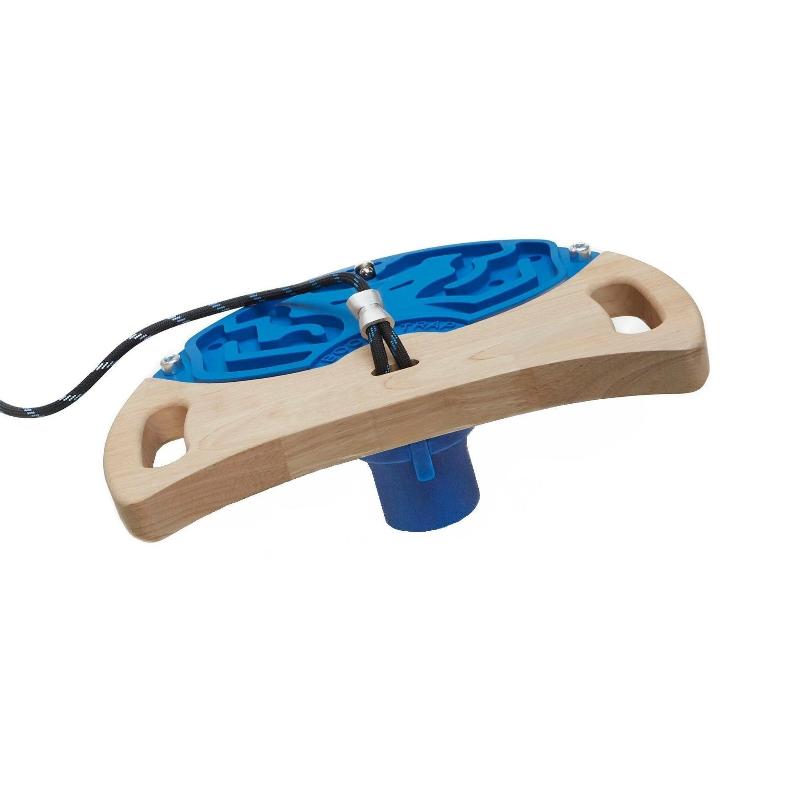
A rolling handle gives you a direct way to load open-hand pulling strength while forcing the wrist and forearm to control rotation. It is especially useful when you want a measurable, progressive exercise for sloper-style force production. Combine it with a loading pin and start progressive overloading.
A rolling bar gives a similar stimulus in a more bilateral or bar-based format. It reduces finger overlap, removes a fixed gripping advantage and forces both hands to maintain pressure under instability.
Use them when you want to train the strength system behind slopers: open-hand flexor force, wrist stability and rotational control.
They do not replace climbing on real slopers.
But they make the strength component much easier to isolate, load and progress.