
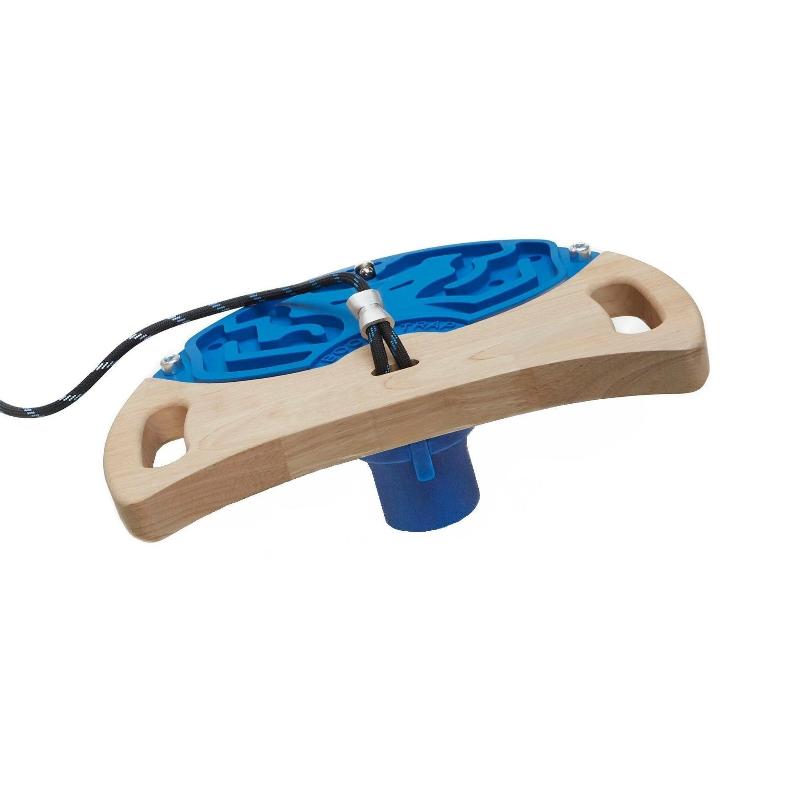


The Core Tension
Every training tool answers one question:
Should I isolate a system — or train it inside climbing movement?
Isolation increases precision.
Integration increases transfer.
Both are valid.
Both have limits.
Most climbers swing blindly between them.
What Isolation Actually Does
Isolation tools reduce variables.
Examples:
- Hangboard → isolates finger flexors
- Pronator/supinator tool → isolates forearm rotation
- Gripper → isolates crushing pattern
- Rolling handle → isolates grip stabilization
Isolation allows:
- Measurable overload
- Clear progression
- Targeting weak links
- Reduced technical noise
It simplifies the stress signal.
The Power of Isolation
Isolation is especially powerful when:
- A specific limiter is identified
- Structural adaptation is required
- Measurability matters
- Coordination is not the bottleneck
For example:
If half crimp force is limiting performance,
a hangboard provides clearer overload than climbing.
If elbow irritation stems from poor rotational control,
a pronator tool may directly address the deficiency.
Isolation sharpens the stimulus.
The Limitation of Isolation
But isolation removes:
- Movement context
- Coordination
- Timing
- Whole-body tension
- Tactical decision-making
Climbing is not a single-joint task.
You do not climb by flexing fingers in isolation.
Transfer is never 100%.
Isolation builds capacity.
Integration teaches application.
What Integration Does
Integrated environments include:
- Training boards
- Steep spray walls
- Routes
- Complex compression problems
These environments:
- Train force inside coordination
- Build intermuscular timing
- Reinforce movement efficiency
- Develop tactical awareness
Integration builds usable strength.
But it reduces load precision.
The Transfer Gradient
Imagine a spectrum:
Highly Isolated → Mixed → Fully Integrated
- Grippers
- Pronator tools
- Hangboard
- Rolling handles
- Board climbing
- Routes
The further right you move:
- Transfer increases
- Measurability decreases
The further left you move:
- Precision increases
- Skill carryover decreases
No position is superior.
Only context determines usefulness.
When Isolation Is Superior
Isolation is often better when:
- Structural adaptation is required
- Early-stage strength deficits exist
- Injury risk must be controlled
- Measurable progression is needed
Isolation reduces chaos.
It clarifies overload.
When Integration Is Superior
Integration is often better when:
- Force ceiling is already high
- Skill application is limiting
- Power expression under coordination matters
- Real climbing performance is near
Integration blends systems.
But blending reduces intensity control.
The Common Mistake
Many climbers:
- Over-isolate and neglect transfer
or - Only integrate and never isolate weaknesses
Both stall progress.
If you only isolate:
You become strong in fragments.
If you only integrate:
Weak links persist unseen.
The Intelligent Approach
Isolation identifies and strengthens bottlenecks.
Integration teaches the system to use them.
Alternating emphasis across blocks creates progression without stagnation.
Isolation builds potential.
Integration expresses it.
The Hidden Recovery Cost
Isolation often stresses tissues deeply but locally.
Integration distributes stress across systems.
This affects recovery planning.
A heavy hangboard phase demands different recovery than a board-heavy phase.
Ignoring this distinction increases injury risk.
The Core Principle
Every tool exists on the isolation–integration spectrum.
The question is not:
“Is this tool good?”
The question is:
“Is isolation or integration the current priority?”
Use isolation to fix weaknesses.
Use integration to express strength.
Confuse the two, and progress blurs.