

Most beginner guides hand you a list of tools and tell you to get stronger. This one starts somewhere different: with the single most important thing nobody tells you when you start climbing.
Your fingers are not ready.
Not yet. Not for hangboards, not for weighted pockets, not for structured finger training. Your muscles will adapt to climbing within weeks. Your tendons — the structures that actually hold everything together — take months to years. That gap between muscular readiness and tendon readiness is where most beginner injuries happen.
So before anything else, understand this: the foundation of beginner climbing training is climbing itself. Everything else comes later, and in a specific order.
Phase 1: Just Climb (Until Your Fingers Tell You They're Ready)
There is no fixed timeline for this. Six months, a year, longer — it depends on your body, your training frequency, and how well you listen to signals. What matters is tendon readiness, not time served.
Signs your fingers are adapting well:
- No unexplained soreness or sharp sensations the day after climbing
- Grip feels stable across different hold types
- No recurring tweaks at the base of your fingers
Signs you're moving too fast:
- Finger soreness that doesn't resolve within 48 hours
- Sharp sensations on small edges or in crimp positions
- Recurring discomfort at the A2 pulley zone (base of ring or middle finger)
During this phase, your only job is to climb consistently, climb with good technique, and recover properly. Two to three sessions per week is enough. More is not better if your tendons can't keep up.
What "training" looks like in Phase 1:
- Climb intentionally — focus on footwork, body positioning, and efficient movement
- Climb silently during warm-up: if your feet make noise on holds, you're not placing them precisely
- Vary hold types and angles rather than repeating the same routes
- Stop before failure, especially on finger-intensive moves
This phase builds the foundation that structured training will eventually load. Skip it and you're building on sand.
Phase 2: Add Antagonist Training and Core Work
Once you're climbing consistently without recurring finger issues, you can start adding supplementary work — but not finger training. Not yet.
The first things to add are the things that protect you, not the things that make you stronger on holds.
Antagonist Training
Climbers pull constantly. The opposing muscles — chest, triceps, shoulder external rotators — get almost no stimulus from climbing itself. Over time this imbalance causes shoulder issues, elbow tendinopathy, and poor posture.
What to do:
- Push-ups or dips: 2–3 sets, 2x per week
- Resistance band external rotations: 3 sets of 15, 2x per week
- Reverse wrist curls or finger extensions: addresses the extensor imbalance from all the gripping
Tools that help:
- A set of resistance bands covers most of this. Theraband or similar — nothing expensive needed.
- Gymnastic rings are excellent for push-up variations and add instability that transfers well to climbing.
Core Training
Core strength in climbing is not about sit-ups. It is about maintaining body tension — keeping your center of gravity close to the wall, staying rigid on overhangs, and transferring force efficiently between feet and hands.
What to do:
- Hollow body holds: the single best climbing-specific core exercise
- Front levers (progressions): directly transfers to overhanging climbing
- Ab roller: effective but requires strict form — a rounded lower back under load causes injury
Tools that help:
- Ab roller: cheap, effective, unforgiving of bad form — look up the correct progression before using it
- Gymnastic rings: hollow body and front lever progressions are easier to scale on rings than a bar
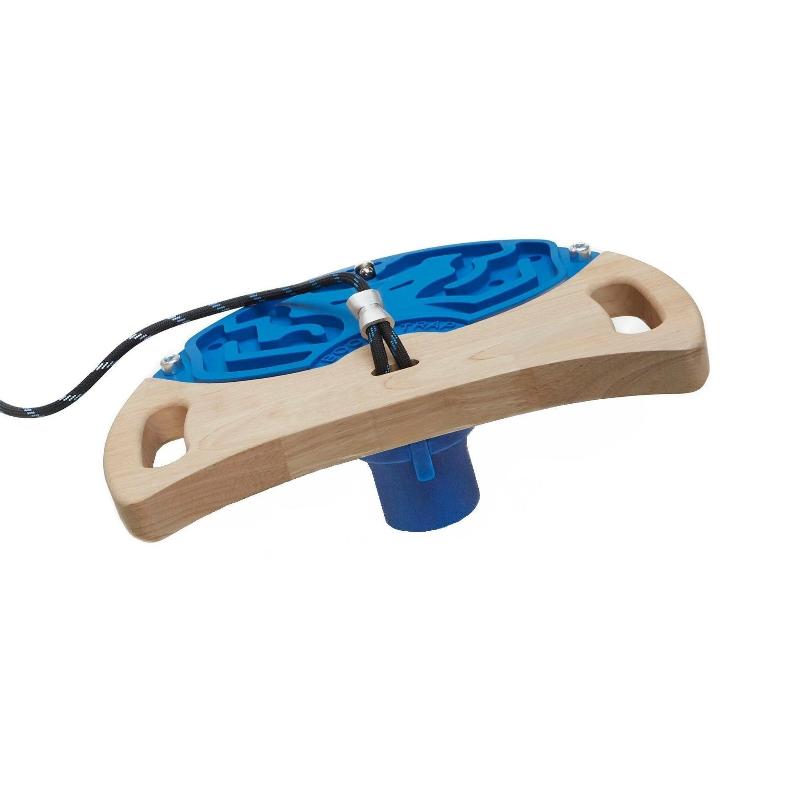
- The Max Maze (if you want something climbing-specific): trains core and contact strength simultaneously in a way that transfers directly to movement on the wall
Phase 3: Introduce Structured Finger Training
This is where most beginner guides start. It should be where yours ends — at least for the first period of your training.
When your fingers are genuinely ready, structured finger training is the highest-leverage thing you can do. The question is what kind, and in what order.
The Right Progression
Start with open-hand, never full crimp.
Full crimp is the strongest grip position but the most dangerous for tendons. Open-hand distributes load more safely and builds the tissue tolerance you need before adding intensity.
Start with large edges and bodyweight only.
The goal of early hangboard work is tendon conditioning, not maximum strength output. A 20–25mm edge, open-hand, bodyweight, for comfortable hangs of 7–10 seconds. If you can't hold a large edge comfortably for 10 seconds, the edge is too small or the load is too high.
Add load only when the current load is easy.
The 2–5% progression rule applies here: increase load by no more than that per week. Tendons adapt slowly. The biggest mistake in finger training is interpreting muscular readiness as overall readiness and jumping ahead.
Hangboards
The most effective tool for structured finger training. Choose wood over resin if you train more than twice a week — wood is significantly more skin-friendly over long training blocks.
Good options:
- Beastmaker 1000 (wood): well-designed edge geometry, good progression range for beginners to intermediate
- YY Vertical Verticalboard First (wood): solid beginner option with appropriate hold selection
What matters more than brand is edge quality and wood type. Avoid cheap resin boards with sharp edge profiles — they load tendons at poor angles and destroy skin.
Portable Edges and Loading Pins
Once you're comfortable with bodyweight hanging and want to add load, a portable edge and loading pin is one of the most effective setups available. It is not a beginner tool — it is a progression tool. But it deserves a mention because it is significantly more versatile than a fixed hangboard for advanced work.
- Hang anywhere with a beam or bar
- Add precise load via a weight belt or loading pin
- Adjust edge depth per session
The loading pin approach — clipping weight directly to a portable edge rather than adding a weight belt — allows very precise load control in small increments, which is exactly what tendon training requires.
Phase 4: Endurance and Power (Much Later)
Most beginners think about this too early. Endurance and power are the top of the pyramid, not the base.
Strength Endurance (Sport Climbing)
Repeaters on a hangboard — short hangs with short rests, repeated over multiple sets — are the primary tool. Only start these when you have a solid max strength base. Doing repeaters before max strength is like running intervals before you can run.
Explosive Power (Bouldering)
Campus boarding is the highest-intensity finger training that exists. It is not a beginner tool by any definition. Most gyms have campus boards — use them for footwork and coordination first, and only add rungs without feet when your fingers have years of conditioning behind them.
The Tools, Summarised by Phase
| Phase | Focus | Tools |
|---|---|---|
| 1 — Just climb | Tendon adaptation, technique | Climbing gym, nothing else |
| 2 — Supplementary | Antagonist balance, core | Resistance bands, rings, ab roller |
| 3 — Finger training | Max strength, open-hand first | Hangboard (wood), portable edge + loading pin |
| 4 — Power/endurance | Sport-specific capacity | Repeaters, campus board |
The Most Common Beginner Mistakes
Hangboarding too early. Tendons aren't ready. You'll feel fine for weeks and then something tweaks.
Full crimping from the start. Full crimp feels strong. It also loads A2 at extreme angles. Learn open-hand first.
Training through finger soreness. Muscle soreness is normal. Finger soreness is a signal. They are not the same thing.
Copying advanced training programs. A program designed for someone with five years of finger conditioning will injure a beginner. Start with the phase that matches your tendon readiness, not your ambition.
Neglecting antagonist work. Shoulder injuries are the second most common climbing injury after finger injuries. They are almost entirely preventable with ten minutes of antagonist work twice a week.
Related Reading
- How Tendons Really Adapt — And Why Most Climbers Rush It — the biology behind why patience in the first year pays off
- Finger Pulley Injuries: A2, A3 & A4 — Causes, Grades and Full Recovery Protocol — what happens when load exceeds tendon readiness
- Crimp vs Open Hand vs Drag: The Mechanical Differences Explained — understanding grip mechanics before you train them
- Max Hangs Protocol: Build Maximum Finger Strength — the structured approach to finger strength once you're ready for it
- Bowstringing Explained: The Root Cause of Pulley Stress in Climbing — the fundamental mechanical failure behind most finger injuries