

Open hand strength is the least structured type of finger training.
Slopers, balls, rolling handles — everything feels similar,
but small differences completely change the stimulus.
That makes progression unclear.
Like any strength quality, open hand strength only improves through:
controlled, repeatable load progression
If your setup doesn’t allow that, the tool doesn’t matter.
The constraint
To train open hand strength, you need:
- a consistent contact surface
- measurable load
- repeatability
Without these, intensity fluctuates too much to track progress.
Shape is not progression
Using a “harder” sloper is not a clean overload.
It changes:
- wrist position
- friction demands
- contact mechanics
So different shapes are different stimuli, not progression.
Progression comes from load, not from worse holds.
Slopers vs rolling handles
This is where most confusion happens.
Slopers (integration)
Slopers are effective — but not for building strength directly.
They:
- depend on friction and skin
- vary between attempts
- change with small position differences
That makes them hard to standardize.
Their role is:
integration — applying strength in a climbing context
They teach you how to use open hand positions on the wall.
Rolling handles (structure)
Rolling handles remove friction dependency.
They force you to:
- control the grip actively
- apply force consistently
- rely on load, not surface conditions
That makes them suitable for:
structured strength development
The system
Open hand strength only becomes trainable when you control load directly.
You need:
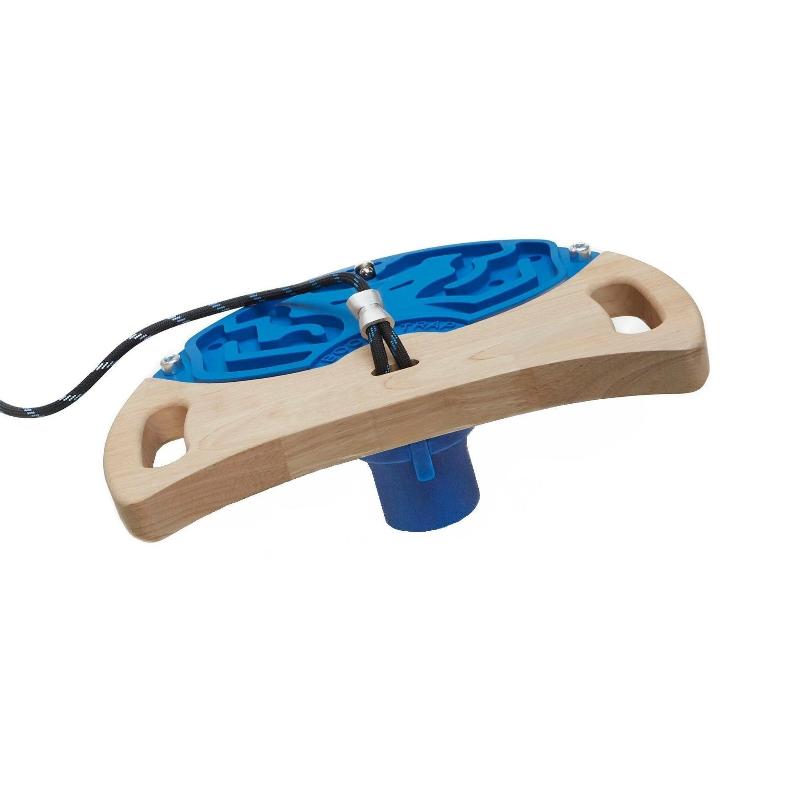
- a consistent handle with 80mm diameter → Workshop 19/50 Rolling Handle
- a loading system → Golden Grip Loading Pin
- adjustable weight → fractional plates
- optional measurement → Tindeq Progressor
That is the system.
Precision
Open hand strength is sensitive to:
- small changes in position
- small changes in load
So consistency matters more than with crimps.
Measurement tools like the Tindeq Progressor don’t change the system —
they make small differences visible once your setup is consistent.
The decision
You are not choosing between slopers.
You are choosing between:
- integration tools (slopers)
- strength tools (rolling handles with load)
Both have value — but they solve different problems.
Bottom line
For strength, you need:
- a stable, consistent handle
- direct loading
- small, measurable increments
For integration, you use slopers.
Mixing both without structure leads to unclear progress.
Training
Once your setup is correct, use it properly.
For rolling handles:
- Max Holds → build top-end strength
- Lift & Lower → train force application in movement
- Controlled Holds → eliminate rotation, build stability
- Density Holds → develop endurance and control
These protocols translate controlled loading into actual performance.