
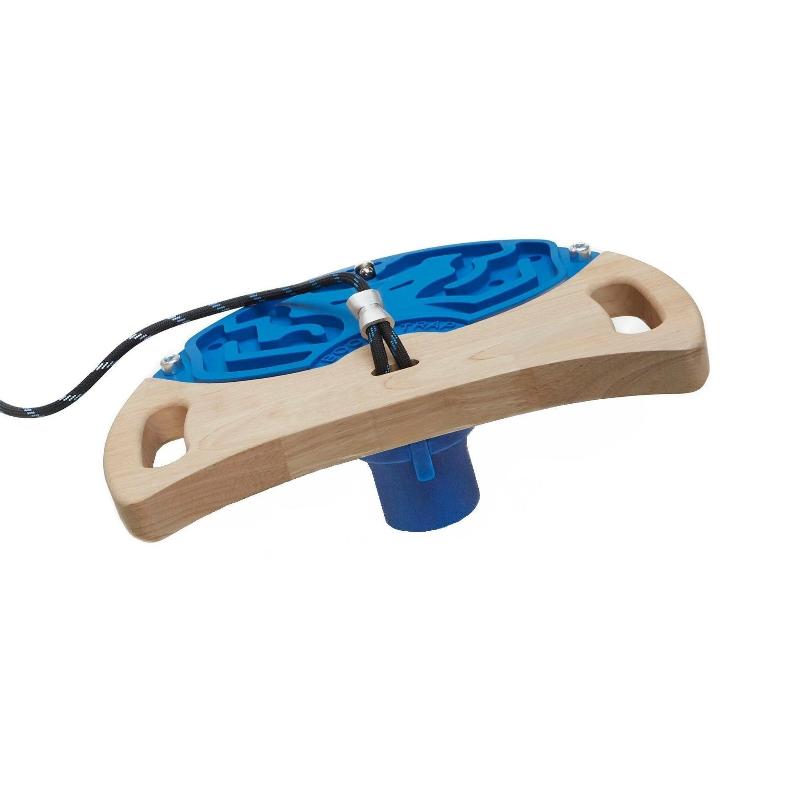


What Grippers Actually Train
Hand grippers emphasize:
- Concentric finger flexion
- Crushing pattern strength
- High neural recruitment in a closed-hand position
Mechanically, this differs from:
- Isometric edge loading
- Open-hand compression
- Friction-dominant grip
Grippers train dynamic closing strength.
Climbing primarily demands sustained isometric force.
This difference matters.
The Biomechanical Mismatch
On a hangboard:
- Fingers flex isometrically
- Joint angles remain relatively stable
- Load is continuous
With a gripper:
- Fingers move concentrically
- Resistance changes across range
- Peak force often occurs mid-closure
This changes:
- Tendon loading pattern
- Joint stress distribution
- Recruitment timing
The neural pattern is not identical.
Transfer is therefore partial.
Where Grippers Can Be Useful
Grippers are valuable for:
- Beginners lacking general forearm strength
- Off-season general preparation (GPP)
- Increasing neural drive in undertrained individuals
- Grip hypertrophy in low-volume phases
They may also help when:
- Access to climbing equipment is limited
- Finger loading must be temporarily reduced
In these cases, they provide general strength stimulus.
Where Grippers Are Limited
Grippers are less useful when:
- Edge strength is the primary limiter
- Half-crimp is underdeveloped
- Sloper instability is the issue
- Advanced climbers need specific overload
Crushing strength does not equal edge strength.
They overlap — but they are not interchangeable.
Neural Carryover vs Specific Carryover
Grippers can increase:
- General neural recruitment capacity
- Maximal voluntary contraction intent
This may indirectly support climbing strength.
But the specific joint angles and contraction types differ.
Specific adaptation still requires edge exposure.
Structural Considerations
Grippers:
- Load tendons dynamically
- Emphasize mid-range joint stress
- Can create repetitive strain if overused
They do not condition:
- Open-hand tolerance
- Small edge exposure
- High torque stabilization
They are general tools.
Not climbing-specific ones.
The Psychological Factor
Grippers feel productive:
- Heavy resistance
- Audible “close”
- Clear difficulty tiers
This can create illusion of direct climbing progress.
But without:
- Edge-based training
- Integrated application
- Transfer testing
Progress may not appear on the wall.
Intelligent Use
Grippers can be integrated:
- In low-intensity deload weeks
- During travel
- As supplementary neural work
- In early strength phases
But they should not replace:
- Hangboard strength
- Board-based applied strength
- Structural reinforcement work
They are accessories.
Not foundations.
The Core Principle
Grippers build crushing strength.
Climbing demands controlled isometric force under friction and torque.
Overlap exists — but it is incomplete.
Used strategically, grippers support development.
Used as primary strength tools, they limit specificity.
Strength must ultimately be trained in the joint angles and force patterns that performance demands.